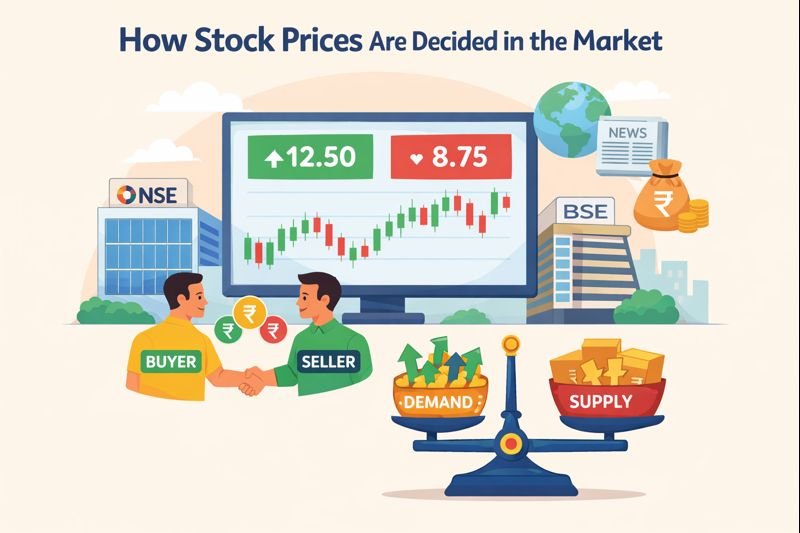
How Stock Prices Are Decided in the Market (Simple Explanation)
If you’ve ever looked at the stock market and wondered,
👉 “Why is this stock going up?”
👉 “Who decides the price of a share?”
You’re not alone. Almost every beginner investor asks this question.
Let’s break it down in very simple, conversational language—no complex formulas, no boring theory.
First Things First: Who Decides Stock Prices?
👉 Short answer:
Buyers and sellers decide stock prices.
There is no company, no government, and no stock exchange that fixes the price of a stock.
Stock prices are decided in the market through a simple rule:
Demand and Supply
Just like vegetables in a market.
Understanding Stock Price with a Real-Life Example 🥦
Imagine tomatoes cost ₹30 per kg today.
-
If many people want tomatoes → price goes up
-
If tomatoes are available everywhere → price goes down
The stock market works the same way.
-
More buyers than sellers → price rises 📈
-
More sellers than buyers → price falls 📉
How Stock Prices Are Decided in the Market
Let’s say you want to buy 1 share of Reliance at ₹2,500.
-
You place a buy order
-
Someone else places a sell order at ₹2,500
-
The moment both prices match → trade happens
✅ That matched price becomes the current market price
This matching happens electronically on exchanges like NSE and BSE.
How Stock Prices Are Decided Using Demand and Supply
📈 When Stock Price Goes Up
-
Many investors want to buy
-
Very few are willing to sell
-
Buyers are ready to pay higher prices
📉 When Stock Price Goes Down
-
Many investors want to sell
-
Few buyers are available
-
Sellers reduce prices to exit
That’s it.
No magic. Just crowd behavior.
Why Does Demand for a Stock Increase?
Here are the main reasons 👇
1️⃣ Company Performance (Most Important)
If a company:
-
Reports higher profits
-
Increases sales
-
Reduces debt
Investors feel confident.
💡 Example:
If Tata Motors reports strong EV sales and profits, more people want to buy its shares → price goes up.
2️⃣ Company News & Announcements 📰
Stock prices react very fast to news.
Positive news:
-
New product launch
-
Big client deal
-
Bonus or dividend announcement
Negative news:
-
Losses
-
Fraud
-
Management issues
📌 Even rumors can move prices in the short term.
3️⃣ Market Sentiment (Mood of Investors)
Sometimes prices move without logic.
-
When investors feel confident → market rises
-
When investors feel scared → market falls
This is called market sentiment.
Example:
-
During COVID panic → markets crashed
-
When recovery hopes came → markets rallied
4️⃣ Economic Factors 🏦
Things like:
-
Interest rates
-
Inflation
-
RBI policies
-
GDP growth
If interest rates go up:
-
Loans become expensive
-
Company profits may fall
-
Stock prices may drop
5️⃣ Global Events 🌍
Indian stock prices are also affected by:
-
US market movement
-
Oil prices
-
Wars or global tensions
Example:
-
Rising crude oil prices → airline stocks fall
-
US market crash → Indian market often follows
6️⃣ Supply of Shares (Promoters & Big Investors)
If:
-
Promoters sell large stake
-
Mutual funds exit a stock
Supply increases → price may fall.
If:
-
Big investors buy heavily
Demand increases → price may rise.
What Is the “Last Traded Price”?
The stock price you see on apps like Zerodha or Groww is:
The price at which the last trade happened
It keeps changing every second because:
-
New buy orders
-
New sell orders
That’s why stock prices never stay fixed.
Does Company Decide Its Own Share Price?
❌ No
A company can:
-
Improve its business
-
Announce results
But it cannot control the share price directly.
The market decides.
How Stock Prices Are Decided Based on Company Performance
Stock prices are decided based on company performance because investors buy shares when they believe a business is doing well and will grow in the future. When a company reports higher profits, increasing revenue, strong cash flow, or reduced debt, demand for its shares usually rises. As more investors want to buy the stock and fewer want to sell, the share price moves up. On the other hand, if a company shows losses, falling sales, or poor management decisions, investors may lose confidence and start selling, which pushes the stock price down. In simple words, better business performance creates trust, and that trust reflects directly in the stock price.
Why Do Good Companies Sometimes Fall?
This confuses beginners a lot 😅
Reasons:
-
Results were good but expectations were higher
-
Overall market is falling
-
Profit booking by investors
📌 Stock price depends on expectation vs reality, not just good or bad.
Intraday vs Long-Term Price Movement
-
Intraday:
Influenced by news, sentiment, traders -
Long-term:
Driven by company fundamentals and growth
👉 Long-term investors should focus less on daily price and more on business quality.
Internal Link (Suggested)
👉 Read next:
Common Stock Market Terms Every Beginner Should Know
Final Thoughts 💡
Let’s simplify everything into one line:
Stock prices are decided by demand and supply, influenced by company performance, news, investor emotions, and the economy.
According to the SEBI, stock prices are driven by market demand and supply mechanisms.
If you understand this,
✅ market movements stop feeling scary
✅ investing becomes more logical