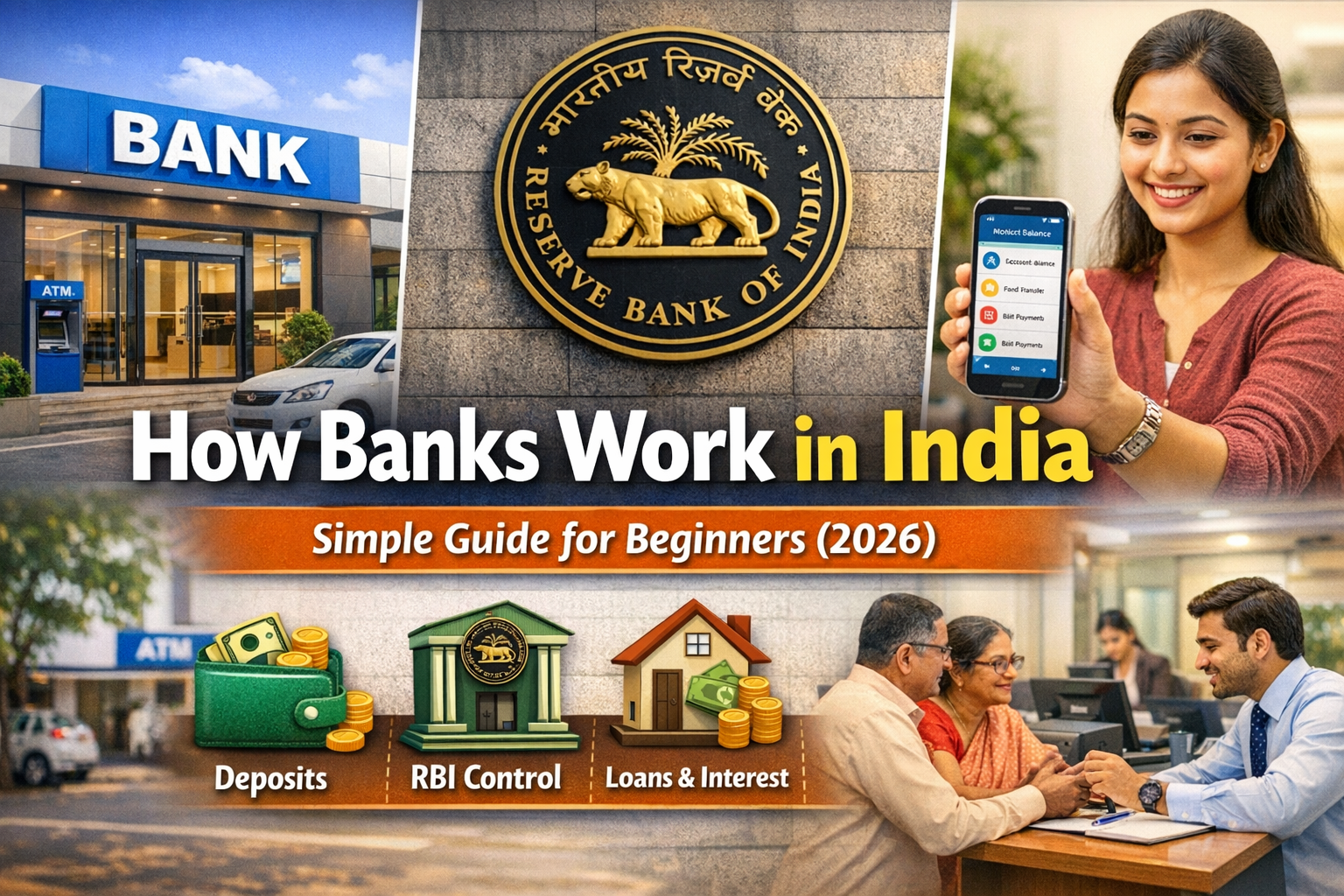
How Banks Work in India Step by Step
Have you ever wondered what actually happens to your money after you deposit it in a bank? Or how banks earn money? Don’t worry — today we’ll understand how banks work in India in very simple, beginner-friendly words, like a friendly conversation.
Whether you are a student, working professional, or just curious about money, this guide will help you understand the Indian banking system in 2026 without confusing financial jargon.
In this guide, we will clearly understand how banks work in India step by step in very simple words.
Let’s begin 😊
What Is a Bank?
In simple words, a bank is a financial institution that:
-
Keeps your money safe
-
Helps you save and grow money
-
Gives loans to people and businesses
-
Provides digital payment services
Banks act like a bridge between people who want to save money and people who need to borrow money.
Who Controls Banks in India?
In India, all banks are regulated by the Reserve Bank of India (RBI).
Think of RBI as the “boss of all banks.”
RBI’s main work is to:
-
Control money supply in India
-
Set interest rates
-
Issue currency notes
-
Make rules for banks
-
Ensure banks are safe and stable
Without RBI, the banking system would be chaotic.
Types of Banks in India (2026)
India has different types of banks. Let’s understand them in simple words.
1️⃣ Public Sector Banks
These banks are owned mainly by the Government of India.
Examples:
-
State Bank of India (SBI)
-
Punjab National Bank (PNB)
-
Bank of Baroda
These banks are large and trusted by millions.
2️⃣ Private Sector Banks
These banks are owned by private companies or shareholders.
Examples:
-
HDFC Bank
-
ICICI Bank
-
Axis Bank
They are known for faster services and strong digital banking.
3️⃣ Small Finance Banks
These banks mainly serve small businesses and rural customers.
Example:
-
AU Small Finance Bank
4️⃣ Payments Banks
They allow deposits and digital payments but cannot give big loans.
Example:
-
Paytm Payments Bank
How Do Banks Actually Work?
Now comes the most important question — how do banks work?
Let’s understand step by step.
Step 1: You Deposit Money
When you open a:
-
Savings Account
-
Current Account
-
Fixed Deposit
You give your money to the bank for safekeeping.
The bank promises:
-
Your money is safe
-
You can withdraw anytime (except FD before maturity)
-
You earn interest (in savings & FD)
Step 2: Bank Uses Your Money to Give Loans
Here’s the interesting part.
The bank doesn’t just keep your money locked in a locker. It uses that money to give loans to:
-
Students (education loan)
-
Home buyers (home loan)
-
Business owners (business loan)
-
Car buyers (car loan)
And here’s how banks earn money 👇
Step 3: The Interest Game
Banks earn profit from the difference in interest rates.
Example:
-
Bank gives you 3% interest on savings account
-
Bank gives loan to someone at 9% interest
That 6% difference (after expenses) is part of the bank’s profit.
This is called the interest spread.
Simple, right?
What Is Interest?
Interest is the extra money paid for borrowing money.
If you take ₹1,00,000 loan at 10% interest, you pay extra ₹10,000 per year (approximately).
Similarly, if you deposit money, the bank pays you interest as a reward for saving.
How Is Your Money Safe?
Many beginners worry:
“What if the bank closes?”
Good question.
In India, deposits up to ₹5 lakh per customer per bank are insured under DICGC (Deposit Insurance and Credit Guarantee Corporation), which works under RBI.
So your money is mostly protected.
How Digital Banking Works in 2026
Banking in India has changed a lot.
In 2026, most people use:
-
Mobile banking apps
-
Internet banking
-
UPI
-
Debit/Credit cards
UPI is managed by National Payments Corporation of India (NPCI).
Apps like:
-
Google Pay
-
PhonePe
-
Paytm
allow instant money transfer 24/7.
This means you don’t even need to visit a bank branch anymore.
What Is CRR and Repo Rate? (Simple Words)
You may hear news about:
-
Repo Rate
-
CRR
-
Inflation
Don’t panic.
Repo Rate is the interest rate at which RBI gives loans to banks.
If RBI increases repo rate:
-
Loan interest rates increase
-
EMIs become expensive
If RBI reduces repo rate:
-
Loans become cheaper
So RBI controls the economy using these tools.
Why Banks Are Important for India
Banks help in:
-
Economic growth
-
Supporting businesses
-
Creating jobs
-
Encouraging savings
-
Controlling inflation
Without banks, economic development would slow down.
They are the backbone of India’s financial system.
Simple Example to Understand Everything
Let’s imagine:
1,000 people deposit ₹10,000 each in a bank.
The bank now has ₹1 crore.
It uses this money to:
-
Give home loans
-
Give business loans
-
Invest safely
People earn interest.
Bank earns profit.
Borrowers build homes & businesses.
Everyone benefits.
That’s how banks work in India.
Common Banking Terms for Beginners
Here are some easy definitions:
-
Savings Account – For saving money
-
Current Account – For business transactions
-
Fixed Deposit (FD) – Lock money for higher interest
-
EMI – Monthly loan payment
-
KYC – Identity verification process
-
Net Banking – Online banking
Final Thoughts (Beginner Friendly Summary)
So now you understand:
-
Banks take deposits
-
Banks give loans
-
Banks earn from interest difference
-
RBI controls banks
-
Digital banking makes life easier
That’s it. No complicated theory.
If you are just starting your financial journey in 2026, understanding how banks work in India is the first smart step.
Now you clearly understand how banks work in India and how they manage deposits, loans, and digital banking services.
Money becomes less confusing once you know the basics.