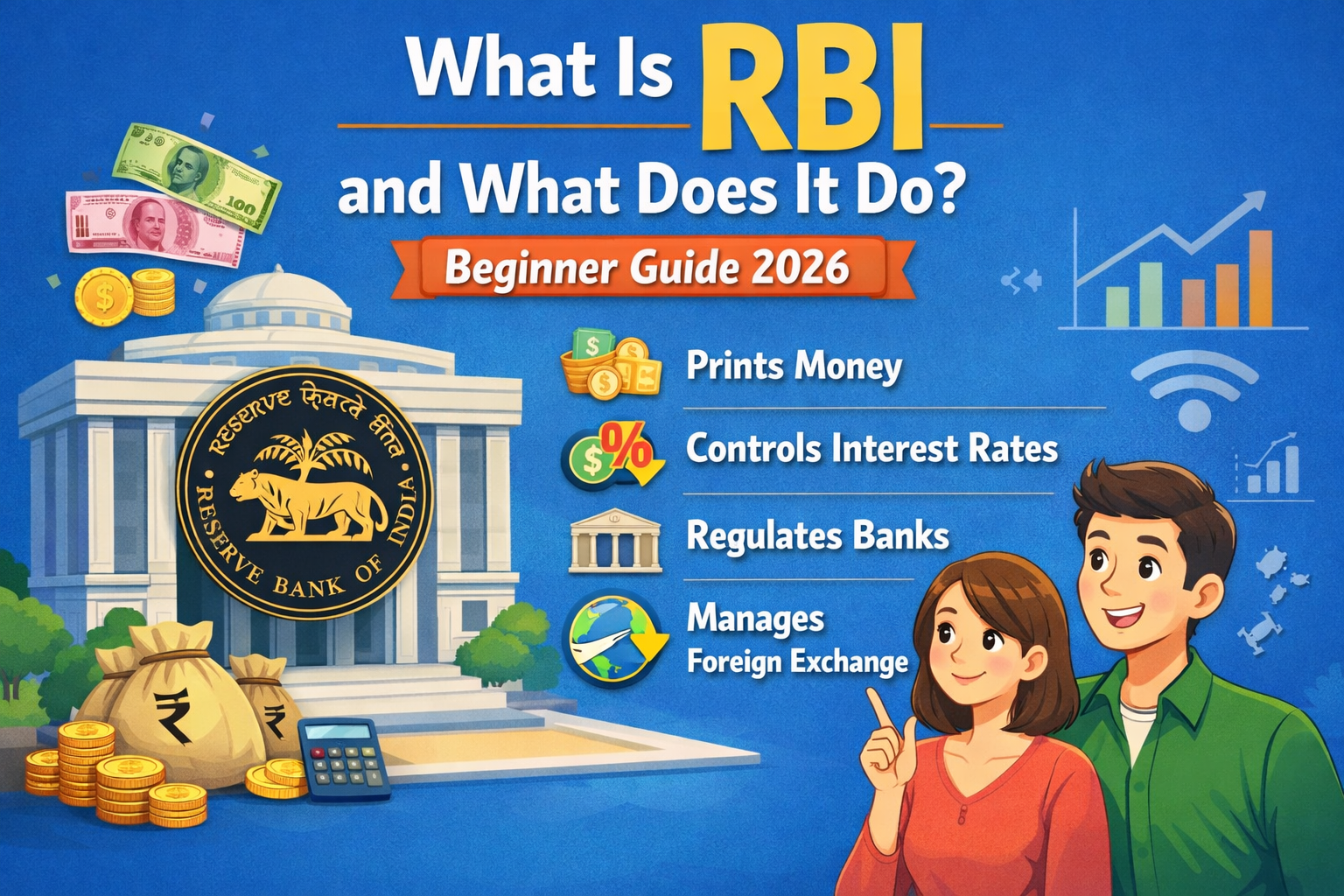
What Is RBI and Why Is It Important in 2026?
If you are wondering what is RBI, you are in the right place.
If you have ever deposited money in a bank, taken a loan, or heard news about interest rates going up or down, you have already felt the impact of RBI.
But what is RBI exactly?
In this beginner-friendly guide, we will have a simple conversation about What Is RBI and What Does It Do in 2026 — without confusing financial jargon.
By the end of this article, you will clearly understand:
-
What RBI stands for
-
Why RBI exists
-
What RBI does for you and the country
-
How RBI controls banks and money
Let’s start from the basics.
What Is RBI?
Reserve Bank of India (RBI) is the central bank of India.
It was established on 1 April 1935.
In simple words:
RBI is the main bank that controls all other banks in India.
Just like a school has a principal to manage everything, India’s banking system has RBI to manage and control it.
Why Does India Need RBI?
Imagine if there was no control over:
-
How much money is printed
-
Interest rates on loans
-
Bank rules
-
Inflation
It would create chaos in the economy.
RBI ensures:
-
Money system runs smoothly
-
Banks work safely
-
Prices don’t rise too fast
-
Financial system stays stable
So yes, RBI plays a very powerful role in India’s economy.
Main Functions of RBI (Explained Simply)
Let’s break down the major functions of RBI in a friendly and easy way.
1️⃣ RBI Prints Currency
RBI is responsible for printing Indian currency notes (except ₹1 note).
If you look closely at any note, you will see:
“I promise to pay the bearer…”
Signed by the RBI Governor.
That means RBI guarantees India’s paper money.
2️⃣ RBI Controls Inflation
Inflation means rising prices.
If inflation becomes too high:
-
Groceries become expensive
-
Fuel prices rise
-
Daily life becomes difficult
RBI controls inflation by adjusting interest rates.
When inflation rises:
-
RBI increases repo rate
-
Loans become expensive
-
Spending reduces
-
Prices slowly stabilize
In 2026, inflation control remains one of RBI’s biggest responsibilities.
3️⃣ RBI Is the Banker’s Bank
Commercial banks like:
-
State Bank of India
-
HDFC Bank
-
ICICI Bank
All these banks keep part of their money with RBI.
If banks face financial trouble, RBI helps them.
That’s why RBI is called:
“Banker of Banks”
4️⃣ RBI Is the Government’s Banker
RBI also works as a banker to the Government of India.
It:
-
Manages government accounts
-
Handles public debt
-
Manages government bonds
-
Facilitates payments
So, RBI supports both banks and the government.
5️⃣ RBI Controls and Regulates Banks
RBI makes rules for banks like:
-
Minimum capital requirements
-
Lending guidelines
-
Customer protection rules
If a bank breaks rules, RBI can:
-
Impose fines
-
Cancel license
-
Restrict operations
This keeps your money safe.
6️⃣ RBI Manages Foreign Exchange
If India imports oil or exports goods, foreign currency is involved.
RBI manages:
-
Foreign exchange reserves
-
Rupee value
-
Currency stability
In 2026, foreign reserves are a big part of economic strength.
7️⃣ RBI Controls Interest Rates
You may hear news like:
-
“RBI cuts repo rate”
-
“RBI increases repo rate”
But what is repo rate?
Repo rate is the rate at which RBI lends money to banks.
If repo rate:
-
Increases → Loans become costly
-
Decreases → Loans become cheaper
So, RBI indirectly controls:
-
Home loan rates
-
Car loan rates
-
Business loan rates
Yes, RBI decisions affect your EMI!
Who Controls RBI?
RBI is headed by a Governor.
As of recent years, the Governor is:
Shaktikanta Das
The RBI Governor:
-
Leads monetary policy
-
Announces repo rate changes
-
Represents India globally
The Monetary Policy Committee (MPC) also helps in decision-making.
What Is Monetary Policy?
Let’s simplify this.
Monetary policy means:
The way RBI controls money supply and interest rates.
Main tools used by RBI:
-
Repo Rate
-
Reverse Repo Rate
-
Cash Reserve Ratio (CRR)
-
Statutory Liquidity Ratio (SLR)
Don’t worry about remembering all these terms.
Just remember:
👉 RBI uses tools to control inflation and economic growth.
How RBI Affects Common People
You may think RBI only affects banks.
But that’s not true.
RBI decisions affect:
-
Your loan EMI
-
Fixed deposit interest
-
Job market
-
Inflation
-
Savings
For example:
If RBI reduces repo rate → Home loans may become cheaper.
So yes, RBI impacts daily life more than you realize.
RBI in 2026: What’s New?
In 2026, RBI is focusing on:
-
Digital payments security
-
Central Bank Digital Currency (CBDC)
-
Cybersecurity in banking
-
Financial inclusion
-
Stable inflation control
India is becoming more digital, and RBI plays a huge role in managing safe digital transactions.
RBI vs Commercial Banks (Simple Comparison)
| RBI | Commercial Banks |
| Controls money supply | Accept deposits |
| Regulates banks | Give loans |
| Prints currency | Provide ATM services |
| Controls inflation | Offer savings accounts |
Think of RBI as the “boss bank”.
Why RBI Is Important for India’s Economy
Without RBI:
-
Inflation could go out of control
-
Banks might fail
-
Currency value could fall
-
Economic growth may suffer
RBI ensures balance between:
-
Growth
-
Stability
-
Inflation
-
Financial safety
It is one of the most powerful financial institutions in India.
Final Thoughts (Simple Summary)
Let’s quickly recap in simple words.
What Is RBI?
RBI is India’s central bank.
What Does RBI Do?
-
Prints money
-
Controls inflation
-
Regulates banks
-
Manages foreign exchange
-
Controls interest rates
-
Acts as banker to banks and government
In 2026, RBI continues to protect India’s financial system and ensure economic stability.
If you want to understand India’s economy, learning about RBI is the first step.
Now you clearly understand what is RBI and how it works in India’s economy.
If you are just starting to learn about finance and banking, don’t worry. Understanding RBI is easier than it sounds — and now you already know the basics 😊
Learn more at the official website of the Reserve Bank of India: https://www.rbi.org.in/
1 thought on “What Is RBI and What Does It Do? (Beginner Guide) in 2026”