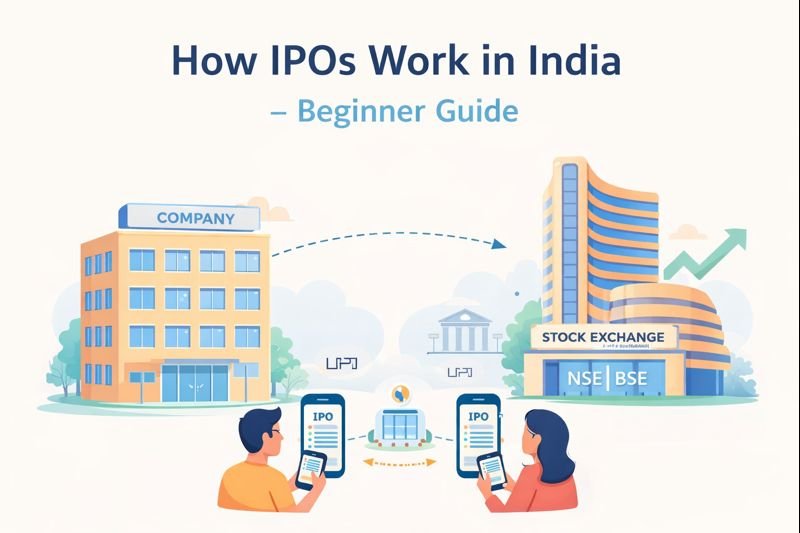
Understanding how IPOs work in India helps beginners make safer investment decisions in the stock market.
If you are new to the stock market, you might have heard people saying,
“IPO aa raha hai” or “IPO mein apply kiya kya?”
For beginners, IPO sounds confusing. But don’t worry 😊
In this article, I’ll explain how IPOs work in India in very simple words—just like a friendly conversation.
No technical language. No confusion. Let’s start.
What Is an IPO? (In Simple Words)
IPO means Initial Public Offering.
When a private company wants to raise money from the public, it sells its shares for the first time.
This process is called an IPO.
👉 In short:
IPO = Company selling shares to common people for the first time
Why Do Companies Bring an IPO?
A company brings an IPO mainly to:
-
Raise money for business expansion
-
Pay off existing loans
-
Improve brand value and trust
-
Allow early investors to exit
Once the IPO is completed, the company becomes a public company.
How IPOs Work in India – Step by Step
Let’s understand the IPO process step by step.
Step 1: Company Decides to Go Public
A company decides that it needs funds.
Instead of taking loans, it chooses to raise money by selling shares to the public.
Step 2: Approval from SEBI
Before launching an IPO, the company must get approval from SEBI (Securities and Exchange Board of India).
SEBI checks:
-
Company financials
-
Business model
-
Risks involved
This protects investors from fraud.
Step 3: IPO Price Is Fixed
The company decides the price of its shares in two ways:
-
Fixed Price IPO – One fixed price
-
Book Building IPO – Price range (example ₹100–₹120)
Most IPOs in India use the book building method.
Step 4: IPO Opens for Subscription
The IPO opens for 3–5 days.
During this time:
-
Retail investors (like us) can apply
-
You apply using your Demat account
-
Money is blocked (not deducted immediately)
Step 5: IPO Allotment
After the IPO closes:
-
Shares are allotted
-
If IPO is oversubscribed, allotment happens through a lottery system
-
If you don’t get shares, money is unblocked
Step 6: Listing on Stock Exchange
Finally, the company’s shares are listed on:
-
NSE
-
BSE
From listing day, shares can be bought and sold like normal stocks.
Who Can Apply for an IPO in India?
You can apply for an IPO if you have:
-
PAN card
-
Demat account
-
Bank account
-
UPI ID
👉 Even beginners can apply easily.
(If you don’t have a Demat account, read this guide:
👉 What Is a Demat Account? How to Open One in India)
Benefits of Investing in IPOs
Here are some simple benefits:
-
Opportunity to invest early
-
Potential listing gains
-
Long-term growth if company performs well
-
Low minimum investment (usually around ₹15,000)
Risks of IPO Investment
IPOs are not risk-free.
Some risks include:
-
Share price may fall after listing
-
Company performance may be weak
-
Market conditions may affect price
👉 Always read the DRHP and company details before investing.
Should Beginners Invest in IPOs?
Yes, beginners can invest—but carefully.
Good approach:
-
Choose well-known companies
-
Invest small amounts
-
Think long-term
-
Avoid applying blindly for every IPO
Common IPO Terms Beginners Should Know
Before applying for an IPO, it is helpful to understand a few basic terms.
Issue Price is the price at which shares are offered during the IPO.
Lot Size means the minimum number of shares you must apply for.
Oversubscription happens when more people apply than the shares available.
Listing Day is the first day when the IPO shares start trading on NSE or BSE.
Knowing these terms makes it easier to understand how IPOs work in India and helps beginners invest with confidence.
Final Thoughts
Understanding how IPOs work in India is very important before investing.
IPOs are a great way to start your stock market journey, but knowledge is your biggest protection.
Start slow, learn continuously, and invest wisely 😊
What Is a Demat Account? How to Open One in India
Stock Market Basics Every Beginner Should Know
Difference Between Trading and Investing
According to SEBI, IPOs are regulated to protect retail investors and ensure transparency in the Indian stock market.
🔗 https://www.sebi.gov.in